
1 LORD, you rule with royal bearing,
clothed in glory, love, and light:
you have robed yourself majestic,
robed yourself with pow'r and might.
Alleluia! Alleluia! Alleluia!
LORD who rules in depth and height!
2 In its everlasting station
earth is fixed to quake no more;
you have laid your throne's foundation;
you yourself are evermore.
Alleluia! Alleluia! Alleluia!
LORD, you are forevermore.
3 With all tones of waters blending,
glorious is the breaking deep;
glorious, beauteous, without ending,
LORD, who reigns on heaven's high steep.
Alleluia! Alleluia! Alleluia!
Songs of ocean never sleep.
4 LORD, the words your lips are telling
are the perfect and the true.
In your high, eternal dwelling,
holiness shall live with you.
Alleluia! Alleluia! Alleluia!
LORD, your Word is ever true.
Source: Christian Worship: Psalter #93A
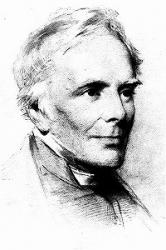
Keble, John, M.A., was born at Fairford, in Gloucestershire, on St. Mark's Day, 1792. His father was Vicar of Coln St. Aldwin's, about three miles distant, but lived at Fairford in a house of his own, where he educated entirely his two sons, John and Thomas, up to the time of their entrance at Oxford. In 1806 John Keble won a Scholarship at Corpus Christi College, and in 1810 a Double First Class, a distinction which up to that time had been gained by no one except Sir Robert Peel. In 1811 he was elected a Fellow of Oriel, a very great honour, especially for a boy under 19 years of age; and in 1811 he won the University Prizes both for the English and Latin Essays. It is somewhat remarkable that amid this brilliantly successful career,… Go to person page >| First Line: | God, the Lord, a King remaineth |
| Title: | God, The Lord, a King Remaineth |
| Author: | John Keble (1839) |
| Meter: | 8.7.8.7.4.4.4.7.7 |
| Language: | English |
| Copyright: | Public Domain |
God the Lord a king remaineth. J. Keble. [Psalm xciii.] First published in his Psalter; or, Psalms of David, 1839, p. 241, in 5 stanzas of 6 lines. It was given in the Sarum Hymnal, 1868, Kennedy, 1863, and in several Public School collections, but its use is not equal to its merits. It is one of Keble's finest renderings of the Psalms.
--John Julian, Dictionary of Hymnology (1907)
My Starred Hymns