
1 Help, LORD, for men of virtue fail,
religion loses ground!
The sons of violence prevail,
and treacheries abound.
Their oaths and promises they break,
yet act the flatt'er'r’s part;
with fair, deceitful lips they speak,
and with a double heart.
2 If we reprove some hateful lie,
they scorn our faithful word:
"Are not our lips our own," they cry,
"and who shall be our Lord?"
Scoffers appear on every side,
where a vile race of men
is raised to seats of pow'r and pride,
and bears the sword in vain.
3 Lord, when iniquities abound,
and blasphemy grows bold,
when faith is rarely to be found,
and love is waxen cold:
is not thy chariot hast'ning on!
Hast Thou not giv'n the sign?
May we not trust and live upon
a promise so divine?
4 "Yes, saith the LORD, "now will I rise,
and make th'oppressors flee;
I shall appear to their surprise,
and set My servants free."
Thy word, like silver sev'n times tried,
thro' ages shall endure:
the men that in Thy truth confide,
shall find Thy promise sure.
Source: Psalms and Hymns to the Living God #12
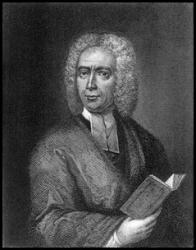
Isaac Watts was the son of a schoolmaster, and was born in Southampton, July 17, 1674. He is said to have shown remarkable precocity in childhood, beginning the study of Latin, in his fourth year, and writing respectable verses at the age of seven. At the age of sixteen, he went to London to study in the Academy of the Rev. Thomas Rowe, an Independent minister. In 1698, he became assistant minister of the Independent Church, Berry St., London. In 1702, he became pastor. In 1712, he accepted an invitation to visit Sir Thomas Abney, at his residence of Abney Park, and at Sir Thomas' pressing request, made it his home for the remainder of his life. It was a residence most favourable for his health, and for the prosecution of his literary… Go to person page >| First Line: | Help, Lord, for men of virtue fail |
| Author: | Isaac Watts |
| Meter: | 8.6.8.6 |
| Language: | English |
| Copyright: | Public Domain |
Help, Lord, for men of virtue fail. I. Watts. [Psalms xii.] Appeared in his Psalms of David, 1719, in 8 stanzas of 4 lines. In addition to its use in its original form, stanzas v., viii. are used as a separate hymn in Spurgeon's Our Own Hymn Book, 1866, as "Lord, when iniquities abound."
--John Julian, Dictionary of Hymnology (1907)
My Starred Hymns