
1 Encouraged by thy word,
Of promise to the poor,
Behold a beggar, Lord,
Waits at thy mercy door;
No hand, no heart, dear Lord but thine,
Can help or pity wants like mine.
2 The beggar's usual plea,
Relief from men to gain,
If offered unto thee
I know thou wouldst disdain:
But those which move thy gracious ear,
Are such as men would scorn to hear.
3 I have no right to say
That though I now am poor,
Yet once there was a day
When I possessed more;
Thou knowest from my very birth,
I've been the poorest wretch on earth.
4 Nor dare I to profess,
As beggars often do,
Though great is my distress,
My faults have been but few;
If thou shouldst leave my soul to starve,
It would be what I should deserve.
5 Nor dare I to pretend
I never begged before,
And if thou now befriend,
I'll trouble thee no more;
Thou often hast relieved my pain,
And often I must come again.
6 Though crumbs are much too good
For such a wretch as I,
No less that children's food
My soul can satisfy;
O do not frown and bid me go;
I must have all thou canst bestow.
7 Nor can I willing be,
Thy bounties to conceal
From others, who like me,
Their wants and hunger feel;
I'll tell them of thy mercy's store,
And try to send a thousand more.
8 Thy ways, thou only wise,
Our thought's and ways transcend,
Far as the arched skies
Above this earth extend:
Such pleas as mine men would not bear;
But God receives a beggar's prayer.
Divine Hymns, or Spiritual Songs: for the use of religious assemblies and private Christians 1800
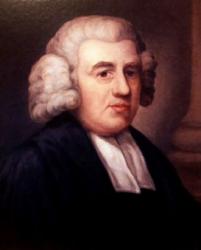
John Newton (b. London, England, 1725; d. London, 1807) was born into a Christian home, but his godly mother died when he was seven, and he joined his father at sea when he was eleven. His licentious and tumultuous sailing life included a flogging for attempted desertion from the Royal Navy and captivity by a slave trader in West Africa. After his escape he himself became the captain of a slave ship. Several factors contributed to Newton's conversion: a near-drowning in 1748, the piety of his friend Mary Catlett, (whom he married in 1750), and his reading of Thomas à Kempis' Imitation of Christ. In 1754 he gave up the slave trade and, in association with William Wilberforce, eventually became an ardent abolitionist. After becoming a tide… Go to person page >| First Line: | Encouraged by thy word |
| Author: | John Newton |
| Language: | English |
| Copyright: | Public Domain |
My Starred Hymns